
Program Overview

Planning and delivery of the Wood First program is a collaborative effort involving the building construction industry, government and the forest sector. Based on recommendations from an advisory group representing a cross-section of primary and secondary manufacturing industries and wood product end-use sectors, FII develops an investment plan that allocates funding on an annual basis.

Activities under the Wood First program are delivered primarily through third-party organizations under a cost-sharing framework between FII and industry. Initiatives are based on the understanding that long-term sustainability of the forest economy includes actively maintaining, creating and diversifying demand for BC forest products.

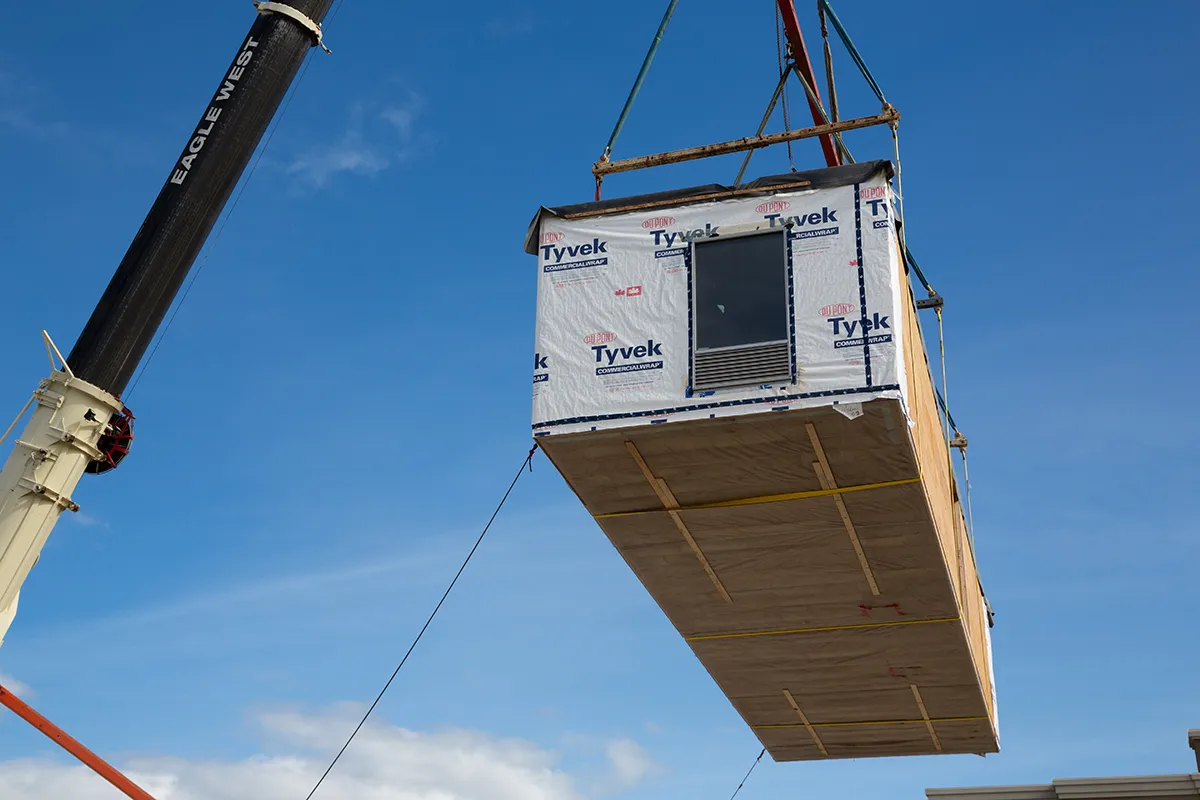
Photo: Modular Housing Construction | Credit: Jason Babakaiff Photography, courtesy Blackbox Offsite Solutions

Program Objectives

Through our Wood First program, FII seeks to:

Strengthen BC’s capacity to produce competitive wood-based products and building systems that create and respond to market demand.

Accelerate adoption of existing and emerging wood-based products and building systems.

Position BC as a world leader in sustainable and innovative wood-based products and building systems in design, production and application.

Funding Process

Each year FII manages a Call for Proposals for the Wood First program, which typically opens in late fall. Though this year’s call is now closed, we invite you to review our process and eligibility information in preparation for next year.

  1. 1.

    Please review all eligibility requirements below carefully to determine whether your organization may apply for funding.

  2. 2.

    All applicants are strongly encouraged to carefully review the Wood First Investment Plan and 3-Year Strategic Plan below.

  3. 3.

    After reviewing our eligibility requirements and applicant resources, please set up a user account within our Recipient Funding Management System below. Once you are registered within our Recipient Funding Management System, you will have access to a variety of information and resources that will help you to submit an application that meets the criteria of FII and our funding partners. Applicants are strongly encouraged to review all resources thoroughly before submitting their applications.

  4. 4.

    If you have any questions regarding the Call for Proposals process, please email us at info@bcfii.ca.

Eligibility

Please review FII’s eligibility information below to determine if you may apply for funding. Please note, FII does not provide loans, grants or subsidies. Funding is not meant to support an individual firm’s activities but rather to benefit sub-sectors or the BC forest sector as a whole.

Those who are eligible to apply for funding under our Wood First program include:

  • Not-for-profit groups or associations representing multi-company interests and serving the objectives of a large geographic area or the majority of producers of a specific species or product category.
  • Academic/research institutions including universities, colleges, and trades.
  • First Nations regional Tribal Councils and Indigenous non-profit organizations.
  • BC Government Ministries/Agencies and Municipal non-profit organizations.

Applicant Information

FII provides guidance and support to applicants for its annual Call for Proposals. If you wish to obtain further resources in preparation for your submission, please visit the Call for Proposals page.

Wood First 3-Year Strategy 2026-2029

Download

Current Wood First Recipients

At FII, we are proud to support a wide variety of organizations within the forest, design and construction industries. We invite you to browse our 2026/27 Wood First funding recipients.

Featured Projects

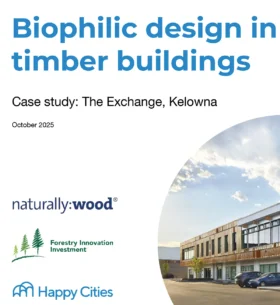
Cover of the report Biophilic Design in Timber Buildings: Case Study: The Exchange, Kelowna, published in October 2025, featuring a photo of The Exchange mass timber building and logos for naturally:wood, Forestry Innovation Investment and Happy Cities.

Measuring benefits of biophilic design

Happy Cities’ post-occupancy evaluation Biophilic Design in Mass Timber Buildings explored the experience of people working at two mass timber buildings at The Exchange in Kelowna. Through surveys, site visits and interviews, researchers examined how the use of wood in common areas influences occupant well-being. They found clear benefits:

  • 87% reported improved mental health in their new office
  • 61% reported improved physical well-being
  • 74% reported stronger collaboration with teammates

To help bring these advantages to more project teams, FII and architectural firm ZGF hosted a speaker panel at BUILDEX Vancouver—one of Canada’s core conferences and tradeshows for property management, interior design, architecture, construction and renovation. The panel previewed FII’s technical handbook, Inside Wood, which provides architects, interior designers and engineers with practical strategies for maximizing the use of exposed wood surfaces. The resource also addresses building codes, detailing, maintenance and biophilic design principles, bringing the health and performance advantages of wood to more people and more projects.

Learn more about biophilia on naturally:wood: naturallywood.com/resources/biophilic-response-to-wood/

Growing impact: Five years and 100+ research projects

Since 2020, FII has funded and cost-shared more than 100 research projects that have shifted how the industry builds with wood and helped modernize codes and regulations. Research on fire safety and seismic resilience has supported key changes to building codes and boosted market confidence and uptake. The research has delivered breakthroughs in:

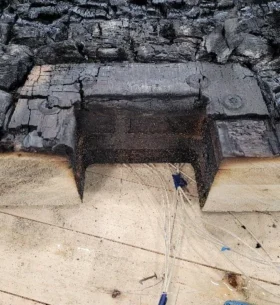
  • Fire safety: FII has funded a portfolio of fire safety research that has strengthened confidence in mass timber buildings. Full scale testing validated two hour fire resistance for mechanically laminated and other mass timber floor systems, directly informing design guidance and standards used in B.C. Additional projects examined encapsulation strategies and allowable exposed timber limits, providing regulators, standards bodies and practitioners with the technical evidence needed to safely advance mass timber use. This work informed both the B.C. Building Code and national building codes and standards, supporting consistent acceptance of mass timber fire safety provisions across jurisdictions.
  • Seismic resilience and structural performance: Dozens of co-ordinated studies have advanced the seismic design of timber structures and supported major code evolution. Full scale testing and multi year research on hybrid systems—including light frame buildings braced by CLT cores, energy dissipating connections and high capacity shear wall systems—demonstrated robust earthquake performance in wood buildings. This body of work confirmed the performance of hybrid mass timber systems, informed national standards such as CSA O86 and related seismic design guidance, and enabled provisions for taller mass timber buildings, including the introduction of 18 storey mass timber construction in the B.C. Building Code.
Photo: FPInnovations

Reduce, reuse, deconstruct—new guide to reduce waste in construction

When older buildings are replaced, much of the material ends up in landfill due to challenges with recycling. This represents a missed opportunity for carbon capture and reducing the environmental footprint of new building construction.

In response, experts at UBC’s School of Architecture and Landscape Architecture (SALA) asked the question, “What if new building construction could be changed to make it easier to recycle buildings when they reach the end of their useful life?” The answer is outlined in the guidebook for Design for Deconstruction in Light Wood Frame Construction—a practical, scalable response to the mounting challenges of construction waste and embodied carbon.

Funded by FII, the project proposes minor but impactful changes to light wood framing construction, such as replacing nailed fasteners with screws, to lower the costs of material recovery. The guide is supported by full-scale mock-ups and practical tips.

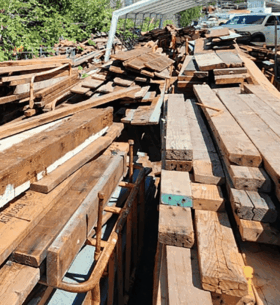
Wood salvaged during deconstruction project in Vancouver, B.C. | Photo: Dr. Haibo Feng

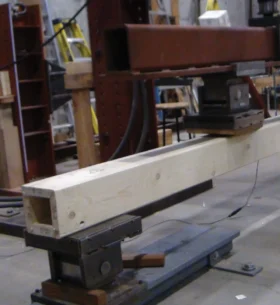
A hollow wood beam mounted on a structural testing machine in a laboratory. The light-coloured beam rests on steel supports while a hydraulic loading frame applies pressure from above. Ladders, equipment and workbenches are visible in the background.

Turning innovation into outcomes

Cost-shared support for individual company manufacturing and marketing development and improvements through UBC’s Centre for Advanced Wood Processing (CAWP) and the BC Wood Specialties Group remained a focus for 2025/26, helping B.C.’s value-added wood manufacturers turn innovation into measurable business outcomes.

  • 17 company-specific projects were delivered by CAWP, focused on cost reduction, automation and new product certification.
  • 14 company-specific marketing, branding, sales and strategic messaging support sessions were delivered through BC Wood Specialties Group to help companies strengthen their market presence, reach new markets and grow their customer base.

    Through these projects, FII is strengthening product innovation, building capacity, improving market responsiveness to changing market conditions, and reinforcing the long‑term competitiveness and resilience of B.C.’s wood supply chain.

Photo: UBC developed the technical data needed to certify Curewood’s hollow‑core S‑P‑F posts, supporting the company’s move toward commercialization | Credit: UBC Centre for Advanced Wood Processing

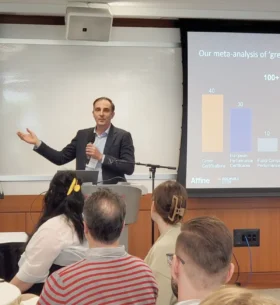
A speaker presents at a conference while standing at a podium and holding a microphone. Attendees are seated in the foreground, facing a projection screen displaying a slide with a bar chart about green building certifications and performance standards.

Building the financial case for mass timber construction

FII’s support of Affine Climate Solutions’ Banking on Buildings Program is helping the financial sector understand, value and fund mass timber projects. By ensuring that the benefits of energy-efficient and resilient building design are reflected in the data lenders use to review financing applications for wood-based construction, the project aims to make it easier for B.C. developers to secure funding.

Affine is now scaling the Banking on Buildings Program across Canada’s largest financial institutions and has trained over 110 banking and insurance professionals on technical considerations unique to mass timber projects. A new Unlocking Mass Timber Finance guide consolidates these insights, with case studies and technical findings helping provide developers and lenders with the knowledge to streamline approvals and accelerate wood construction.

This program began three years ago when FII funded Affine to work directly with lenders like Vancity, BMO and RBC to integrate mass timber considerations into their official underwriting and lending protocols so that wood’s performance characteristics would be recognized in project risk assessments. The team also conducted research on the total cost of ownership in affordable housing, finding that while hybrid mass timber can cost more upfront, it reduces construction timelines and significantly lowers embodied carbon. Affine’s review of more than 100 research studies further confirmed that energy-efficient and green-certified buildings outperform financially, with better value retention and lower default risk. Affine has now integrated these findings into a practical decision-making framework that is used internally and in collaboration with financial institutions to support their underwriting and lending discussions.

Photo: Affine Climate Solutions

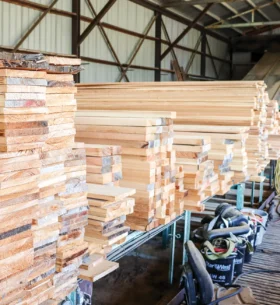
Stacks of cut lumber drying on racks inside a sawmill or wood-processing facility, with rows of boards extending through the building.

Expanding Indigenous supply chains through materials and resources guides

First Nations-led projects are supporting self-determination, local capacity and the informed use of local wood resources.

Through the Construction Foundation of BC’s Local Materials Inclusion Guide, Indigenous housing leaders, builders and forestry professionals co-developed two new practical guides grounded in on-reserve realities that address barriers related to land codes (First Nations land governance), timber rights, grading and scale. Engagement with more than 25 Indigenous and non-Indigenous experts ensured the tools reflect diverse community contexts and development pathways.

A long-form guide addresses key technical and regulatory considerations for First Nations forestry and wood product initiatives, while a short-form guide supports early decision-making by helping builders, administrators, community leaders and business partners map local resources and identify strategic partnerships.

Complementing this work, FII supported the BC First Nations Forestry Council (FNFC) to lead province-wide stakeholder identification, engaging all 204 First Nations in B.C. to better understand forestry priorities and active businesses. FII also helped unlock opportunities for new business relationships between First Nations and manufacturers in the forest sector by supporting FNFC’s BusinessConnect initiative.

Photo credit: Construction Foundation of BC

For an overview of our recipient projects completed in 2025/26, please download our Year in Review

Download Year in Review (PDF)